Bloomberg Law Examines the CFTC’s Advisory Strategy as Crypto and Prediction Markets Gain Institutional Ground
Braeden Anderson, Sr. was quoted in Bloomberg Law’s article, “Crypto, Prediction Market Chiefs Gain Sway as CFTC Advisers,” by Ben Miller, where he discussed the CFTC’s evolving approach to prediction markets.
The article analyzes a significant early move by newly appointed Commodity Futures Trading Commission Chairman Michael Selig: the formation of an Innovation Advisory Committee populated by senior executives from leading crypto exchanges, prediction market platforms, and traditional trading venues.
Chairman Selig’s decision to appoint executives from firms such as Polymarket, Gemini, Nasdaq, and Cboe comes at a moment when the CFTC stands on the cusp of dramatically expanded authority. Pending crypto market structure legislation would place the agency at the center of digital asset regulation, while ongoing litigation and state-level challenges continue to test the CFTC’s jurisdiction over prediction markets and event-based contracts.
As Bloomberg Law notes, advisory committees have long served as a mechanism for agencies to gather technical input from market participants. What distinguishes Selig’s approach is both the prominence of the selected advisers and the timing. With four commissioner seats currently vacant, the committee members will have unusually direct access to the chairman as the agency defines its regulatory priorities.
In commenting on the significance of prediction markets’ inclusion within the CFTC’s innovation framework, Anderson emphasized that this move reflects a deliberate institutional position rather than regulatory ambivalence:
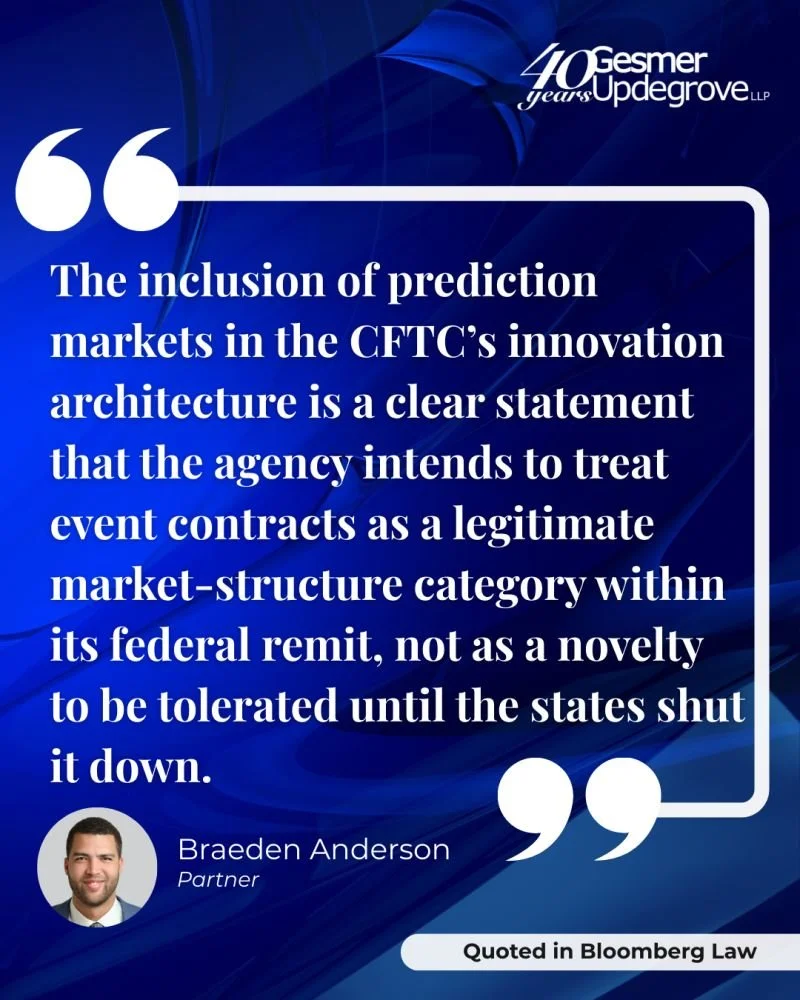
“The inclusion of prediction markets in the CFTC’s innovation architecture is a clear statement that the agency intends to treat event contracts as a legitimate market-structure category within its federal remit, not as a novelty to be tolerated until the states shut it down.”
The article highlights the tension between federal oversight and state enforcement actions, including a recent Massachusetts court ruling enjoining Kalshi’s sports prediction market. Against that backdrop, Anderson cautioned against oversimplifying the chairman’s posture toward any single platform while underscoring the importance of leadership resolve:
“I would not frame Selig as ‘pro-Kalshi’ in any cheerleading sense, but I also would not assume he will shy away from defending the CFTC’s institutional lane. Everyone is looking to Selig to provide backbone here.”
Bloomberg Law further situates the advisory committee within a broader political environment in which the Trump administration has reduced the number of federal advisory panels, raising concerns about whether agencies will lack meaningful stakeholder input. At the same time, lawmakers and critics have questioned whether industry-heavy committees risk skewing regulatory outcomes in favor of regulated entities. Unlike some proposed advisory bodies at other agencies, however, the CFTC’s committee remains subject to the Federal Advisory Committee Act’s balance requirements, including representation from public interest groups and academics.
The developments outlined in the article suggest that the CFTC is actively positioning itself to shape the future of crypto markets, prediction markets, and event contracts as durable components of U.S. financial market infrastructure. For exchanges, platform operators, financial institutions, and investors, the agency’s evolving approach carries important implications for compliance strategy, jurisdictional risk, and the direction of future enforcement.
- - - - - - - - - - - - -
About the author:
K. Braeden Anderson is a Partner at Gesmer Updegrove LLP, where he leads the firm’s Securities Enforcement & Investigations practice, and chairs Mackrell International’s Blockchain & Digital Assets Group and Securities Enforcement & Investigations Group. He is a nationally recognized securities regulatory and enforcement attorney whose practice sits at the intersection of traditional financial regulation and emerging technology. He has been recognized in Best Lawyers: Ones to Watch® in America (2025) for Financial Services Regulation Law and Securities Regulation, and was named the #1 most-read fintech thought leader in the United States in Mondaq’s Spring 2025 Thought Leadership Awards.
Before joining Gesmer Updegrove, Braeden founded a Washington, D.C.–based law firm. He previously served as Assistant General Counsel at Robinhood Markets, Inc. (NASDAQ: HOOD), advising on high-stakes regulatory and enforcement matters, and earlier practiced at Kirkland & Ellis LLP and Sidley Austin LLP in New York and Washington, D.C.
Braeden is a prominent voice in securities and crypto regulation and a leading example of how lawyers can build brand through education and content. He publishes a weekly newsletter reaching more than 20,000 legal and financial professionals, runs a YouTube channel with over 160,000 subscribers, and regularly produces written and multimedia thought leadership through his blog, Anderson Insights. His work focuses on enforcement trends, fintech regulation, and the evolving role of digital assets in capital markets.