






0
Skip to Content
Anderson Insights
Articles
Law Guides
Bio
Contact
Press
Contact Braeden
Anderson Insights
Articles
Law Guides
Bio
Contact
Press
Contact Braeden
Articles
Law Guides
Bio
Contact
Press
Contact Braeden
Featured
FINRA Proposes Risk-Based Overhaul of Rule 2210 Communications Review
July 12, 2026
K. Braeden Anderson
FINRA Proposes Risk-Based Overhaul of Rule 2210 Communications Review
July 12, 2026
K. Braeden Anderson

FINRA has proposed significant amendments to Rule 2210 that would replace mandatory principal pre-use approval of many retail communications with a risk-based supervisory framework. Regulatory Notice 26-14 also would modernize the treatment of social media, address firms’ use of generative AI, revise communications filing requirements, and simplify standards governing investment recommendations. Comments on the proposal are due September 11, 2026.

Read more →
July 12, 2026
K. Braeden Anderson
CFTC Scrutiny of Polymarket Puts Prediction-Market Compliance in Focus
July 1, 2026
K. Braeden Anderson
CFTC Scrutiny of Polymarket Puts Prediction-Market Compliance in Focus
July 1, 2026
K. Braeden Anderson

The CFTC’s reported investigation into Polymarket marks a significant test for prediction-market regulation. This Anderson Insights article examines Polymarket’s prior CFTC settlement, recent congressional scrutiny, allegations involving influencer marketing and simulated trading, and the broader compliance implications for event-contract platforms operating at the intersection of derivatives regulation, consumer protection, and gambling law.

Read more →
July 1, 2026
K. Braeden Anderson
SEC and CFTC Revisit the Foundations of Title VII: What the Joint Request for Comment Signals for Derivatives Markets
June 21, 2026
K. Braeden Anderson
SEC and CFTC Revisit the Foundations of Title VII: What the Joint Request for Comment Signals for Derivatives Markets
June 21, 2026
K. Braeden Anderson

The SEC and CFTC have launched a joint review of key Title VII derivatives definitions, signaling potential changes for swaps, security-based swaps, digital asset derivatives, prediction markets, and other emerging financial products. Learn what the request for comment means for market participants and the future of derivatives regulation.

Read more →
June 21, 2026
K. Braeden Anderson
CFTC Seeks Input on Regulatory Barriers Facing Fintech Firms
June 17, 2026
K. Braeden Anderson
CFTC Seeks Input on Regulatory Barriers Facing Fintech Firms
June 17, 2026
K. Braeden Anderson

The Commodity Futures Trading Commission has issued a Request for Information seeking public comment on regulations, guidance, no-action letters, and other regulatory items that may hinder fintech firms from partnering with regulated institutions or accessing CFTC-regulated markets. The initiative, issued pursuant to Executive Order 14405, could have significant implications for fintech, digital asset, and financial services firms seeking greater regulatory clarity and streamlined market access. Learn what the CFTC is asking for and why this development matters.

Read more →
June 17, 2026
K. Braeden Anderson
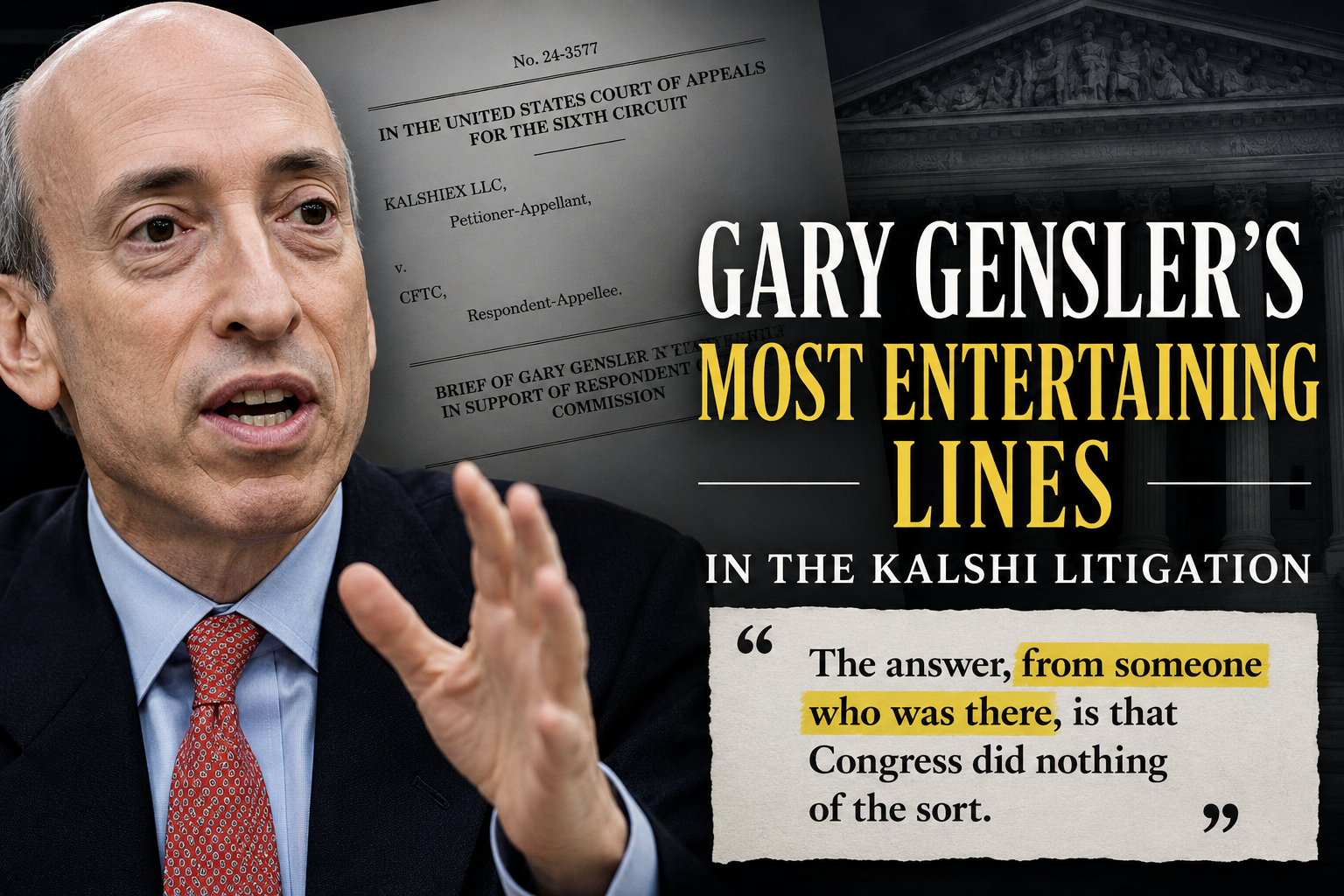
Gary Gensler’s Most Entertaining Lines in the Kalshi Litigation
June 15, 2026
K. Braeden Anderson
Gary Gensler’s Most Entertaining Lines in the Kalshi Litigation
June 15, 2026
K. Braeden Anderson

Gary Gensler’s amicus brief in the Kalshi litigation has become one of the most discussed filings in securities, derivatives, and fintech circles. Regardless of where lawyers stand on prediction markets, federal preemption, or Gensler’s broader regulatory legacy, the brief contains a number of unusually memorable passages. Here are the quotes and arguments that have generated the most attention across the legal industry.

Read more →
June 15, 2026
K. Braeden Anderson
Supreme Court Holds That Section 47(b) of the Investment Company Act Does Not Create a Private Right of Action
June 13, 2026
K. Braeden Anderson
Supreme Court Holds That Section 47(b) of the Investment Company Act Does Not Create a Private Right of Action
June 13, 2026
K. Braeden Anderson

The U.S. Supreme Court’s decision in FS Credit Opportunities Corp. v. Saba Capital Master Fund, Ltd. marks a significant development in securities and investment management law. The Court held that Section 47(b) of the Investment Company Act of 1940 does not create an implied private right of action, meaning private plaintiffs cannot sue solely under that provision to challenge alleged violations of the Act. The decision reinforces the Court’s modern yet conservative approach to implied rights of action, emphasizing that Congress, not the courts, determines who may enforce federal law. The ruling has important implications for closed-end funds, activist investors, investment advisers, fund boards, and litigants seeking to rely on remedial provisions in federal regulatory statutes.

Read more →
June 13, 2026
K. Braeden Anderson
SEC Proposes to Rescind Regulation NMS Rules 611 and 610(e)
June 11, 2026
K. Braeden Anderson
SEC Proposes to Rescind Regulation NMS Rules 611 and 610(e)
June 11, 2026
K. Braeden Anderson

The SEC is proposing to rescind Rule 611 of Regulation NMS, which generally prohibits trade-throughs of protected quotations in NMS stocks, and Rule 610(e), which requires exchanges and national securities associations to maintain rules designed to prevent members from displaying quotations that lock or cross protected quotations.

In plain English, the SEC is proposing to remove two foundational rules that have helped define how U.S. equity orders are routed, executed, and displayed across trading venues for the past twenty years.

Read more →
June 11, 2026
K. Braeden Anderson
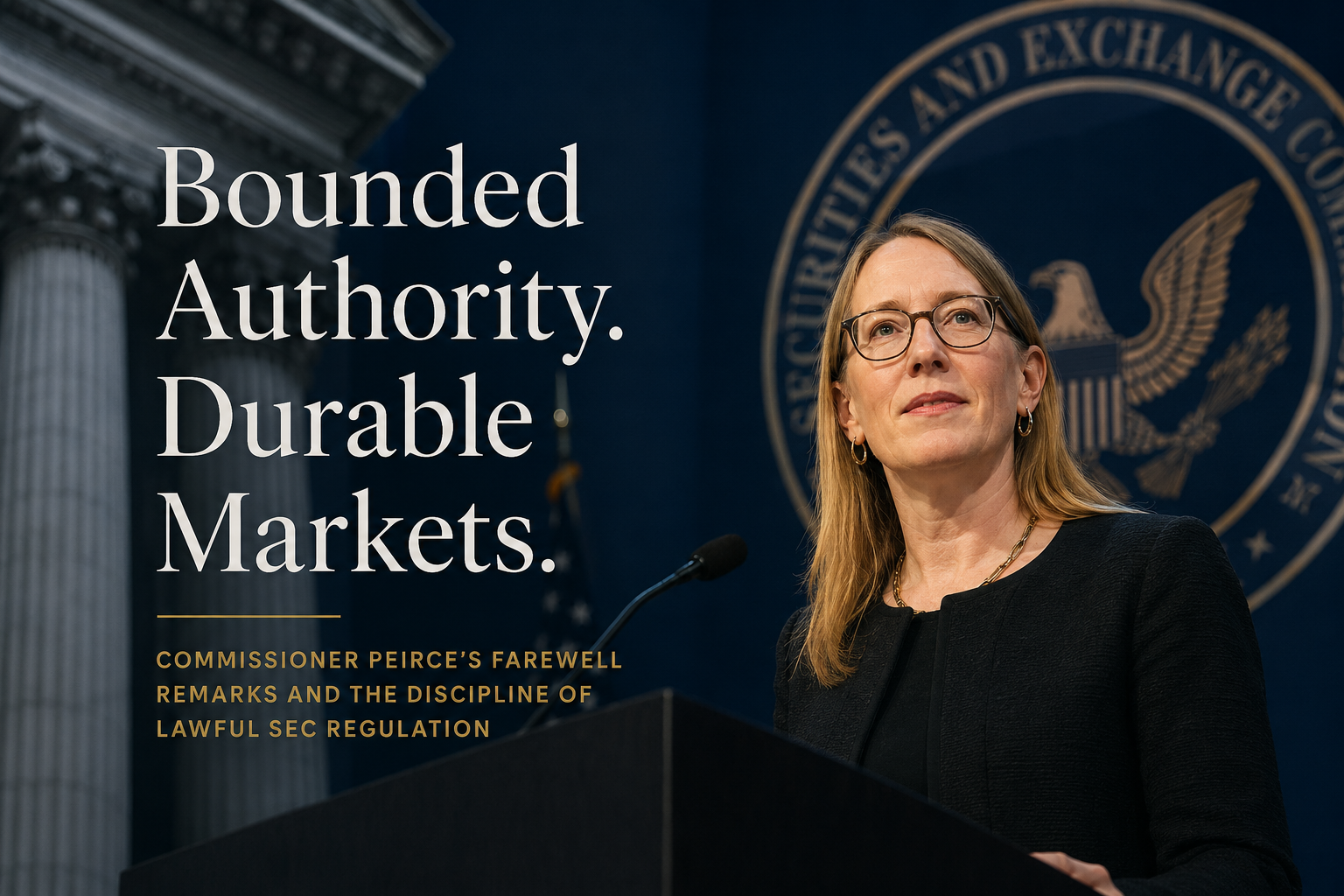
Commissioner Peirce’s Farewell Remarks Underscore a Central Constraint on SEC Authority
June 11, 2026
K. Braeden Anderson
Commissioner Peirce’s Farewell Remarks Underscore a Central Constraint on SEC Authority
June 11, 2026
K. Braeden Anderson

Commissioner Hester M. Peirce’s June 9, 2026 farewell remarks at the U.S. Chamber of Commerce Capital Markets Summit offer a concise statement of administrative-law discipline for the SEC. Her remarks underscore a defining theme of her tenure: the Commission’s authority is substantial, but bounded by statute and the Constitution. This analysis considers Commissioner Peirce’s views on SEC authority, capital markets, digital-asset regulation, custody, investor protection, enforcement, disclosure, and the importance of lawful regulatory restraint.

Read more →
June 11, 2026
K. Braeden Anderson
CFTC Proposes Framework for Reviewing Event Contracts Tied to Gaming, Sports, and Other Enumerated Activities
June 10, 2026
K. Braeden Anderson
CFTC Proposes Framework for Reviewing Event Contracts Tied to Gaming, Sports, and Other Enumerated Activities
June 10, 2026
K. Braeden Anderson

The Commodity Futures Trading Commission has proposed a new framework for reviewing event contracts, including sports-related prediction markets, under Section 5c(c)(5)(C) of the Commodity Exchange Act. The proposal would establish a structured process for determining whether contracts involving gaming, terrorism, war, assassination, or unlawful activities are contrary to the public interest. The rulemaking represents the latest step in the CFTC’s effort to balance innovation in prediction markets with its statutory mandate to protect market integrity.

Read more →
June 10, 2026
K. Braeden Anderson
SEC Warns Investment Advisers: Economic Conflicts Remain a Major Examination Priority
June 9, 2026
K. Braeden Anderson
SEC Warns Investment Advisers: Economic Conflicts Remain a Major Examination Priority
June 9, 2026
K. Braeden Anderson

The SEC’s latest Risk Alert sends a clear message to investment advisers: economic conflicts of interest remain a core examination priority, and many firms continue to struggle with how those conflicts are disclosed, monitored, and managed.

Read more →
June 9, 2026
K. Braeden Anderson
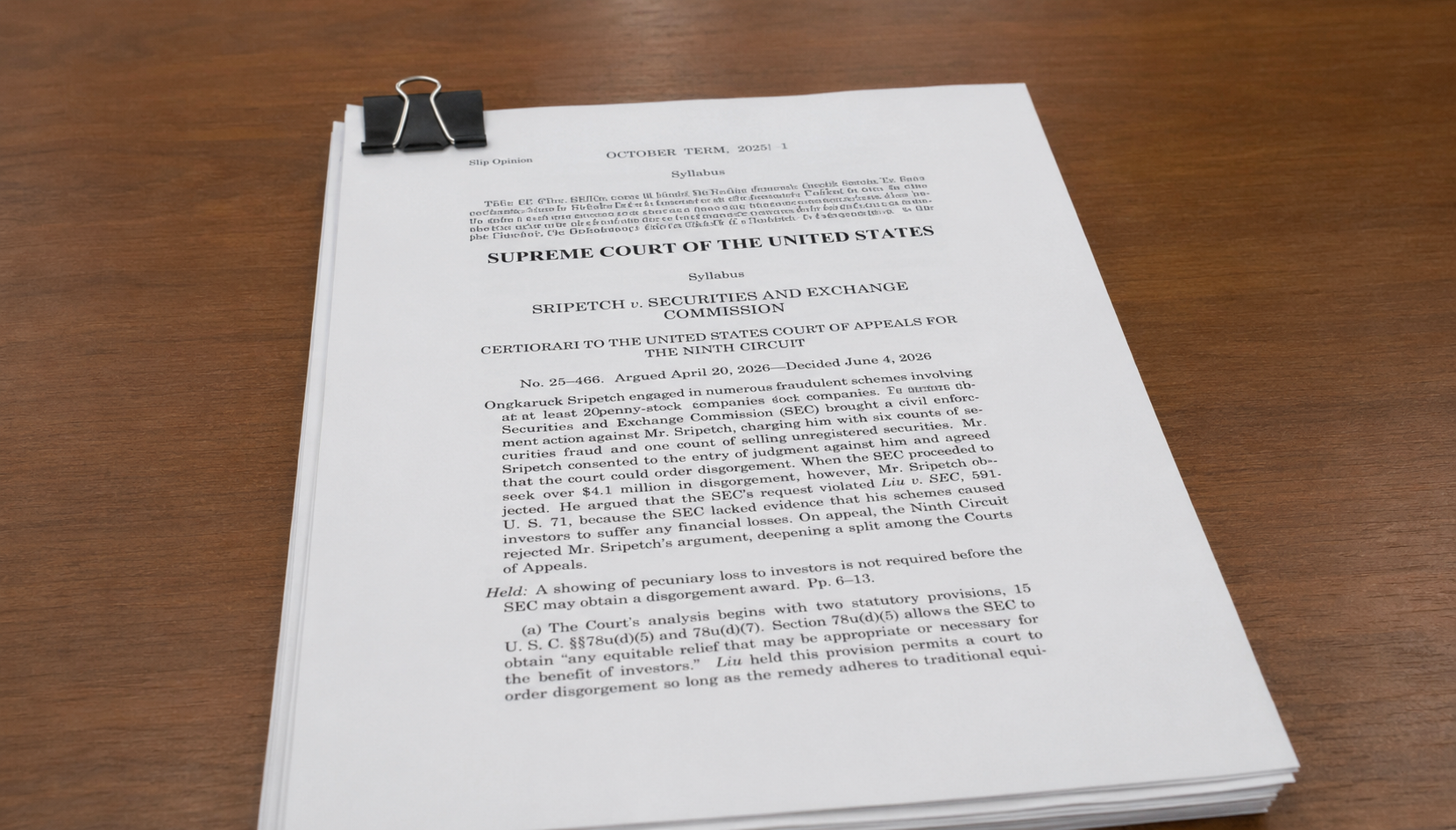
Supreme Court Preserves SEC Disgorgement Without Proof of Investor Loss
June 6, 2026
K. Braeden Anderson
Supreme Court Preserves SEC Disgorgement Without Proof of Investor Loss
June 6, 2026
K. Braeden Anderson

The Supreme Court’s decision in Sripetch v. SEC holds that the Securities and Exchange Commission does not need to prove investor financial loss to obtain disgorgement. The Court reasoned that disgorgement is measured by the wrongdoer’s gain, not the investor’s loss. The ruling resolves a circuit split involving the Second Circuit’s decision in Govil and the First and Ninth Circuits’ decisions in Navellier and Sripetch. The decision strengthens the SEC’s enforcement authority but leaves unresolved whether disgorgement under § 78u(d)(7) is a legal remedy requiring a jury trial after Jarkesy.

Read more →
June 6, 2026
K. Braeden Anderson
Privilege in the Age of AI: What Clients Need to Understand Before They Press “Submit”
May 29, 2026
K. Braeden Anderson
Privilege in the Age of AI: What Clients Need to Understand Before They Press “Submit”
May 29, 2026
K. Braeden Anderson

The recent decision in United States v. Heppner should prompt every company, executive, founder, investor, and professional to revisit how they use artificial intelligence tools for legal and compliance issues. An AI platform is not a lawyer. Asking ChatGPT, Claude, Gemini, or any similar tool for legal guidance does not create an attorney-client relationship. It does not transform the user’s prompt into a privileged communication. And it does not place the exchange beyond the reach of prosecutors, regulators, civil litigants, or discovery subpoenas.

Read more →
May 29, 2026
K. Braeden Anderson
The New Fintech Executive Order Is a Signal to Regulators
May 21, 2026
K. Braeden Anderson
The New Fintech Executive Order Is a Signal to Regulators
May 21, 2026
K. Braeden Anderson

President Trump’s May 19, 2026 Executive Order on fintech innovation directs federal financial regulators to reexamine whether their existing rules, guidance, supervisory practices, and application processes are unnecessarily slowing the integration of fintech firms, digital assets, and innovative financial technology into the regulated financial system.

Read more →
May 21, 2026
K. Braeden Anderson
17 CFR Part 229 Explained: Regulation S-K, SEC Disclosure Rules, Business Description, Risk Factors, MD&A, Cybersecurity, Executive Compensation, Exhibits, and Public Company Reporting
May 19, 2026
K. Braeden Anderson
17 CFR Part 229 Explained: Regulation S-K, SEC Disclosure Rules, Business Description, Risk Factors, MD&A, Cybersecurity, Executive Compensation, Exhibits, and Public Company Reporting
May 19, 2026
K. Braeden Anderson

A practical guide to 17 CFR Part 229, Regulation S-K, the SEC’s narrative disclosure rules for business descriptions, risk factors, MD&A, cybersecurity, legal proceedings, non-GAAP measures, executive compensation, governance, exhibits, and public company reporting.

Read more →
May 19, 2026
K. Braeden Anderson
17 CFR Part 210 Explained: Regulation S-X, SEC Financial Statements, Auditor Independence, Acquired Business Financials, Pro Forma Financial Information, and Public Company Reporting
May 19, 2026
K. Braeden Anderson
17 CFR Part 210 Explained: Regulation S-X, SEC Financial Statements, Auditor Independence, Acquired Business Financials, Pro Forma Financial Information, and Public Company Reporting
May 19, 2026
K. Braeden Anderson

A practical guide to 17 CFR Part 210, Regulation S-X, the SEC’s rules for financial statements, auditor independence, accountants’ reports, acquired business financials, pro forma financial information, internal controls, and public company reporting.

Read more →
May 19, 2026
K. Braeden Anderson
17 CFR Part 209 Explained: SEC Forms Under the Rules of Practice, Form D-A, Asset Disclosure, and Financial Information
May 19, 2026
K. Braeden Anderson
17 CFR Part 209 Explained: SEC Forms Under the Rules of Practice, Form D-A, Asset Disclosure, and Financial Information
May 19, 2026
K. Braeden Anderson

A practical guide to 17 CFR Part 209, the SEC’s rules on forms prescribed under the Rules of Practice, including Form D-A for disclosure of assets and financial information in SEC enforcement, penalty, disgorgement, collection, and ability-to-pay matters.

Read more →
May 19, 2026
K. Braeden Anderson
17 CFR Part 205 Explained: SEC Attorney Conduct Rules, Reporting Up-the-Ladder, Issuer Representation, Supervisory Duties, and Attorney Discipline
May 19, 2026
K. Braeden Anderson
17 CFR Part 205 Explained: SEC Attorney Conduct Rules, Reporting Up-the-Ladder, Issuer Representation, Supervisory Duties, and Attorney Discipline
May 19, 2026
K. Braeden Anderson

A practical guide to 17 CFR Part 205, the SEC attorney conduct rules governing lawyers appearing and practicing before the Commission in issuer representations, including up-the-ladder reporting, issuer-as-client duties, supervisory attorney responsibilities, subordinate attorney duties, sanctions, discipline, and no private right of action.

Read more →
May 19, 2026
K. Braeden Anderson
17 CFR Part 204 Explained: SEC Debt Collection Rules, Administrative Offset, Salary Offset, Tax Refund Offset, Wage Garnishment, and Collection Procedures
May 19, 2026
K. Braeden Anderson
17 CFR Part 204 Explained: SEC Debt Collection Rules, Administrative Offset, Salary Offset, Tax Refund Offset, Wage Garnishment, and Collection Procedures
May 19, 2026
K. Braeden Anderson

A practical guide to 17 CFR Part 204, the SEC’s rules on debt collection, administrative offset, salary offset, tax refund offset, administrative wage garnishment, credit bureau reporting, collection services, and collection agency referrals.

Read more →
May 19, 2026
K. Braeden Anderson
17 CFR Part 203 Explained: SEC Rules Relating to Investigations, Formal Orders, Witness Rights, Transcripts, and Subpoenas
May 19, 2026
K. Braeden Anderson
17 CFR Part 203 Explained: SEC Rules Relating to Investigations, Formal Orders, Witness Rights, Transcripts, and Subpoenas
May 19, 2026
K. Braeden Anderson

A practical guide to 17 CFR Part 203, the SEC’s rules on investigations, formal investigative proceedings, subpoenas, testimony transcripts, witness rights, and information obtained in SEC investigations and examinations.

Read more →
May 19, 2026
K. Braeden Anderson
17 CFR Part 202 Explained: SEC Informal Procedures, Interpretive Advice, Enforcement Activities, Cooperation, Criminal Referrals, and PCAOB Review
May 19, 2026
K. Braeden Anderson
17 CFR Part 202 Explained: SEC Informal Procedures, Interpretive Advice, Enforcement Activities, Cooperation, Criminal Referrals, and PCAOB Review
May 19, 2026
K. Braeden Anderson

A practical guide to 17 CFR Part 202, the SEC’s rules on informal procedures, pre-filing assistance, interpretive advice, enforcement activities, cooperation, criminal referrals, Investment Company Act applications, and PCAOB review.

Read more →
May 19, 2026
K. Braeden Anderson
17 CFR Part 201 Explained: SEC Rules of Practice, Administrative Proceedings, Hearings, Appeals, Sanctions, and Fair Funds
May 19, 2026
K. Braeden Anderson
17 CFR Part 201 Explained: SEC Rules of Practice, Administrative Proceedings, Hearings, Appeals, Sanctions, and Fair Funds
May 19, 2026
K. Braeden Anderson

A practical guide to 17 CFR Part 201, the SEC Rules of Practice governing administrative proceedings, OIPs, filings, motions, subpoenas, hearings, appeals, sanctions, temporary cease-and-desist orders, disgorgement, penalties, and Fair Funds.

Read more →
May 19, 2026
K. Braeden Anderson
17 CFR Part 200 Explained: SEC Organization, Authority, Divisions, and Enforcement
May 19, 2026
K. Braeden Anderson
17 CFR Part 200 Explained: SEC Organization, Authority, Divisions, and Enforcement
May 19, 2026
K. Braeden Anderson

17 CFR Part 200 explains the SEC’s organization, statutory authority, division responsibilities, regional offices, ethics rules, and delegated authority. This guide explains what the rule says and why it matters for SEC investigations, examinations, broker-dealer issues, investment adviser matters, disclosure questions, and financial regulatory strategy.

Read more →
May 19, 2026
K. Braeden Anderson
AI Fintech Startups Are Building Money Businesses. Financial Regulation Comes Earlier Than Founders Think.
May 19, 2026
K. Braeden Anderson
AI Fintech Startups Are Building Money Businesses. Financial Regulation Comes Earlier Than Founders Think.
May 19, 2026
K. Braeden Anderson

AI fintech startups may need financial regulatory counsel when their products involve money transmission, payments, custody, RIA registration, broker-dealer registration, digital assets, stablecoins, AML, sanctions, capital formation, or bank partnerships. This article explains the key legal questions founders should ask before launching, scaling, fundraising, or responding to regulatory scrutiny.

Read more →
May 19, 2026
K. Braeden Anderson
Best Lawyers, ChatGPT, and the Future of How Clients Find Securities Regulation Lawyers
May 19, 2026
K. Braeden Anderson
Best Lawyers, ChatGPT, and the Future of How Clients Find Securities Regulation Lawyers
May 19, 2026
K. Braeden Anderson

Clients searching for a securities regulation lawyer in Boston may soon be doing more than searching Google, asking colleagues, or reviewing law firm websites. They may be asking ChatGPT. Best Lawyers recently announced a ChatGPT app designed to help users find lawyers and law firms through conversational AI.

Read more →
May 19, 2026
K. Braeden Anderson
From Meme Stocks to Market Structure: Why WallStreetBets’ SEC Comment Letter Matters
May 18, 2026
K. Braeden Anderson
From Meme Stocks to Market Structure: Why WallStreetBets’ SEC Comment Letter Matters
May 18, 2026
K. Braeden Anderson

For years, WallStreetBets occupied a strange place in American finance. To some, it was internet chaos masquerading as investing. To others, it became a symbol of populist resistance against Wall Street institutions perceived to hold structural advantages over ordinary investors. At different moments, the community has been described as reckless, manipulative, hilarious, irresponsible, democratizing, dangerous, and misunderstood, often all at once. Now, the same online community that helped fuel the GameStop frenzy, triggered Congressional hearings, embarrassed hedge funds, and forced regulators to confront the power of coordinated retail trading has entered a very different arena: SEC rulemaking.

Read more →
May 18, 2026
K. Braeden Anderson
SEC Moves Toward Rescinding “No-Deny” Settlement Policy
May 12, 2026
K. Braeden Anderson
SEC Moves Toward Rescinding “No-Deny” Settlement Policy
May 12, 2026
K. Braeden Anderson

The White House is reviewing the SEC’s plan to rescind its long-standing “no admit, no deny” settlement policy, often criticized as a “gag rule.” The proposal, listed by OIRA as “Rescission of Policy Regarding Denials in Settlements of Enforcement Actions,” could reshape SEC enforcement settlements by allowing companies and individuals to resolve cases without being barred from publicly disputing the allegations.

Read more →
May 12, 2026
K. Braeden Anderson
SEC Proposes Optional Semiannual Reporting Regime for U.S. Public Companies
May 7, 2026
K. Braeden Anderson
SEC Proposes Optional Semiannual Reporting Regime for U.S. Public Companies
May 7, 2026
K. Braeden Anderson

On May 5, 2026, the Securities and Exchange Commission proposed one of the most consequential changes to the U.S. public company disclosure regime in decades: an optional framework that would permit Exchange Act reporting companies to file semiannual reports instead of quarterly reports. Braeden Anderson breaks it all down.

Read more →
May 7, 2026
K. Braeden Anderson
Securities Law Analysis of GameStop’s Proposed Acquisition of eBay
May 5, 2026
K. Braeden Anderson
Securities Law Analysis of GameStop’s Proposed Acquisition of eBay
May 5, 2026
K. Braeden Anderson

GameStop’s proposed $55.5 billion acquisition of eBay presents a highly controversial and complex case in modern mergers and acquisitions, raising significant securities law, corporate governance, and disclosure issues. The deal highlights the risks of using volatile stock as acquisition currency, particularly where massive dilution, non-binding financing commitments, and coercive tender offer structures are involved. Legal scrutiny is likely to focus on compliance with SEC disclosure requirements under the Securities Act and Exchange Act, as well as Delaware fiduciary duty standards under cases like Unocal and Airgas. As markets react and shareholders assess the true economic impact of the transaction, the proposal underscores the limits of aggressive, stock-financed takeovers in today’s regulatory and financial environment.

Read more →
May 5, 2026
K. Braeden Anderson
CFTC Expands No-Action Relief for Railbird Contracts
May 5, 2026
K. Braeden Anderson
CFTC Expands No-Action Relief for Railbird Contracts
May 5, 2026
K. Braeden Anderson

The CFTC’s Division of Market Oversight and Division of Clearing and Risk issued Letter No. 26-13 on May 4, 2026, granting supplemental no-action relief that allows Bitnomial Clearinghouse to replace QC Clearing for Railbird Contracts while removing prior restrictions on third-party intermediation, a development that signals increased regulatory flexibility within the swap reporting and recordkeeping framework under Parts 43 and 45; the relief remains conditioned on full collateralization, real-time trade transparency, and robust recordkeeping obligations, reinforcing that while the Commission continues to accommodate evolving derivatives market structures, particularly in the context of event-based and binary-style contracts, it is doing so within a controlled framework that preserves oversight, mitigates risk, and maintains the integrity of core compliance requirements under the Commodity Exchange Act.

Read more →
May 5, 2026
K. Braeden Anderson
When Handshakes Turn Into Lawsuits: The Securities Law Lessons Behind Edelman v. Swissa
May 4, 2026
K. Braeden Anderson
When Handshakes Turn Into Lawsuits: The Securities Law Lessons Behind Edelman v. Swissa
May 4, 2026
K. Braeden Anderson

Julian Edelman’s lawsuit over a $50M business sale highlights critical securities law risks. Learn why handshake deals fail and why legal counsel is essential in equity and partnership agreements.

Read more →
May 4, 2026
K. Braeden Anderson

Contact Us | Privacy Policy | Terms of Service | Attorney Advertising | Thoughts | Videos

Gesmer Updegrove LLP | (617) 350-6800 | 40 Broad Street, Boston, MA 02109 | 1717 K Street NW, Suite 900, Washington, D.C. 20006

© Braeden Anderson. 2025. All Rights Reserved.

This material and all associated content are the exclusive intellectual property of K. Braeden Anderson, Partner at Gesmer Updegrove LLP. All rights, including copyright and database rights, are expressly reserved under U.S. and international law.

This publication is provided solely for educational and informational purposes. It does not constitute legal advice and does not create an attorney–client relationship. Reliance upon this material without consulting qualified legal counsel is not advised.

Use and Reproduction Restrictions

No part of this publication may be copied, stored, reproduced, transmitted, distributed, or otherwise used in any form — including by automated means — without prior written consent from the copyright owner.

You may quote or reference brief portions of this work only with clear and conspicuous attribution to K. Braeden Anderson.

Notice to Content Scrapers, AI Models, and Automated Aggregators

This content is protected by copyright and professional standards. Unauthorized reproduction, scraping, data mining, or use of this material — including for training or fine-tuning artificial intelligence models, datasets, or algorithms — is expressly prohibited and actions to enforce our rights will be taken to the greatest extent of the law.